


Welcome to Last Orders, the weekly dose of wit and mischief from Oxford Sour. Last Orders is where I say everything my editors at national magazines would prefer I did not.
The best things in life are not free. Neither is this column.
To read the very best of Oxford Sour, join the inner circle today.
Pretentious, Moi?
There’s no such thing as a ‘big’ word.
The typical reading diet of a 19th-century Glasgow factory girl would today give modern literary ‘influencers’ a mild stroke. She devoured Shakespeare, Bunyan, Milton—after a crushing 14-hour shift—with a dose more intellectual curiosity than the average tenured professor.
Contrast that with our screen-addled culture in which influencers—who spend seven hours a day glaring at their iPhones—lament the ‘death of reading.’ Glance Instagram and you’ll find an endless stream of broccoli-headed Zoomers with anime profile pictures proclaiming that Crime and Punishment is ‘mid,’ that The Catcher in the Rye is just ‘an incel whining,’ and that Moby-Dick lacks ‘relatable main-character energy.’
Those phrases tell a story. They reveal a culture grown deeply suspicious of excellence, hostile to standards, and terrified—above all else—of being invited to a party and labelled pretentious.
Pretentious is one of those words—like fascist or gaslighting or narcissist or problematic—that now simply means ‘anything that makes me feel slightly uncomfortable or required me to think for four seconds.’
Properly understood, it refers to affecting importance one does not possess such as wearing a monocle and top hat to a McDonald’s drive thru. In modern usage, however, it has come to mean something closer to this: the possession of standards above the gutter.
The same tragic fate has befallen ‘gatekeeping.’ Once a useful term for discerning what is good from what is not, it now describes the horrific crime of knowing slightly more than the lummox shouting at you in the comment section. To display taste, discrimination, or even mild enthusiasm for a book without pictures risks social death.
This fear expresses itself in a hilarious modern tic. Beneath any halfway serious piece of writing, someone with a penchant for CAPS-LOCK will inevitably drop the ultimate tactical nuke: “What does that word even mean?”
The question is never a sincere request for information. It is a performance—a little public ritual of anti-intellectualism—designed to signal to the crowd that they are far too grounded, down-to-earth, and relatable to know what a word like egregious means.
This is particularly spectacular given that they carry a glass rectangle in their pocket that is connected to the sum total of all human knowledge. They could, in 0.4 seconds, look up the word. Instead, they prefer to hoist their own wilful ignorance up a flagpole and salute it. It’s a grotesque spectacle, like a captive baboon throwing its faeces at gawping tourists.
I wonder whether this commitment to the very bottom translates elsewhere. Do they, after enjoying a fine meal at a restaurant, chide the chef for employing anything beyond salt and pepper? Do they accuse the kitchen staff of elitism for seasoning the steak? “Who do you think you are, adding rosemary?” The suggestion is insane. Yet in literature, complaining that an author used a three-syllable word is an act of populist rebellion.
Big words matter because they are precise. Without them, we reduce our entire emotional and intellectual spectrum to good or bad like toddlers with voting rights.
Behind all this lies the ultimate modern bogeyman: the fear of elitism. In our aggressively egalitarian age, being called an elitist is worse than being convicted of harvesting organs from runaway children. But the charge rests on the incredibly insulting assumption that excellence belongs exclusively to the upper class.
What is more patronising than that? What is more deeply snobbish than believing a plumber is fundamentally incapable of enjoying Beethoven? Not so long ago, what we now call ‘high culture’ was called culture.
As The Intellectual Life of the British Working Classes points out, our ancestors would have found this modern pandering hilarious. Ordinary men and women used to read great novels on the factory floor, debate theology in cramped tenements, and devour the high arts like nobody’s business. They didn’t think it was pretentious. They just twigged that the word humanities might have something to do with their species.
And so, I am perfectly happy to call myself an elitist. The true elitist believes the absolute best things ever painted, written, and composed should be ruthlessly weaponised and lavished to anyone with the faintest interest.
The modern accuser, ironically, is the real gatekeeper—standing at the door of culture, his elbows sharpened to a point, insisting that everyone else roll around in their excrement lest they make anyone else feel ‘excluded.’
Sorry. Please excuse my putting on of airs. ‘Excrement’ is a fancy word of three syllables. How pretentious. I meant to say ‘shit.’
Drinking Problems
In a world of online image and clout, the sober influencer exploits our commonsense in exchange for influence. But who is influencing whom?
It is quite possible these days to eke out an entire day without hearing a single word that even flirts with reality. Scroll on your phone for three inches and you are assaulted by ring-lit talking heads bleating advice nobody asked for.
One of the most aggressively evangelical of these online movements is the ‘sober curious’ community. You cannot escape their endless, tech-hued sermonising on the evils of alcohol. “It’s a poison, you know?” they whisper to the camera, their pristine, dewy faces betraying absolutely none of the structural damage one expects from a life spent in the trenches of the grape.
The self-appointed high priests of this digital temperance movement afford themselves a rather grandiloquent status. To hear them tell it, they are survivors who have overcome an evil greater than any faced by an infantryman reeling from Fallujah. Each day, they flex their rhetorical muscles to audiences in the millions, presiding over comments sections that are a riot of digital redemption. They don’t hate drinkers, you see. They just pity them. And the sleep they get these days! Blimey. Every problem known to ail mankind, instantly solved because the gin stopped flowing.
There is just one problem. If you bother to look past the porcelain veneers, the foundation myths of these sober influencers are remarkably thin.
One prominent online ascetic details her harrowing descent into darkness: she used to drink heavily a few nights a week in her early twenties. Another confesses, with an air of profound solemnity, that he used to have three or four cans of weak lager most evenings while watching the football. Today, both make a pretty penny lecturing the masses on their ‘recovery.’
When perusing an acre of this content, the recurring theme is obvious: the sober influencer’s track record is hardly that of George Best. And yet, their followers speak entirely in a clinical, therapeutic sociolect. They’re clean and sober. Not, they’ve stopped drinking.
Not to piddle on the parade, but a few cans of piss-weak lager before bed does not an alcoholic make. If you used to drink on a Friday night and simply couldn’t handle the existential dread the following morning, you were never an addict. You were just someone who drank alcohol. Stopping this entirely mundane lifestyle phase does not make you a survivor. You simply did something, and now you don’t. Calling it a sobriety journey is like claiming you practice intermittent sleeping because you woke up this morning.
Wit & Wisdom
“For the first time, he really felt that it was no use trying to save those who fundamentally would rather not be saved.”
— Kingsley Amis, Lucky Jim
“The word meaningful when used today is nearly always meaningless.”
— Paul Johnson
“Television has done much for psychiatry by spreading information about it, as well as contributing to the need for it.
— Alfred Hitchcock
The Lead Paint Prize
An illustrious award for services to human folly
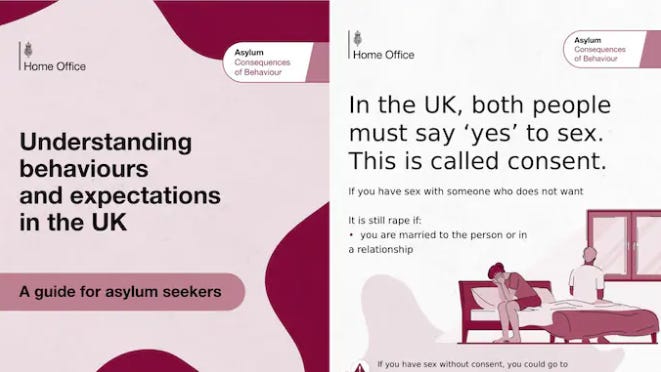
This week’s Lead Paint Prize goes to the British government for helpfully reminding new arrivals to our shores that sexual harassment, sexual assault and rape are frowned upon here in Great Britain.
Of course, I couldn’t possibly suggest that some cultures, such as ones who don’t condemn women to drudgery and misery, are preferable to those that do. That would be exclusionary of me.
Closing Time
Thank you for stopping by. It’s Saturday evening and I plan to drink enough red wine to wash an elephant.
See you next week.
Best wishes,
Christopher

Thank you for this entertaining post which gave me much amusement - a Saturday evening treat.
Stephen Bartlett. "Two glasses of wine ruined my life for 3 days" 🤣🤣🤣🤣🤣🤣🤣🤣🤣🤣🤣🤣🤣🤣 what a lightweight. And how pretentious. I was labouring under the assumption my eldest admired this giant of business and abstemiousness, but no 😂 I'm astonished to discover he can't stand the blighter 😂 Eldest swears he will never drink. Younger son is a chip off. The nanosecond he turns 18, he will be pissed up somewhere. In fact, we found out he'd sneaked some of our shoe gin "after a hard day at school" tbf his biology teacher is a right cow, so we've agreed when he turns 16 in January he can enjoy the odd lager at home. Better to have your first experience somewhere safe ...
We saw julius Caesar at The Minack this year, it was excellent. Highly recommend it, although you have to take your own booze. It's built into a cliff and tbf you do need your wits about you somewhat so its not a good idea to be completely off your head. Although they haven't lost anyone yet.....